10 Best Frizerly Alternatives Worth Trying
Your content tool stopped earning its subscription the moment it started producing drafts you rewrite from scratch. Most people switch after watching costs climb while output quality flattens, or after realizing the platform was never built for their workflow. Finding a replacement that actually fits takes more than a list of names.
This article breaks down ten Frizerly alternatives, starting with Autoblogging.ai as the best overall pick, then covering Koala AI, Agility Writer, SEOWriting.ai, Scalenut, Outrank, Emplibot, AutoPost, RankYak, and theStacc. You will also get the criteria that separate a real upgrade from a lateral move, so you can pick the right tool in one pass.
What to Look For in Frizerly Alternatives
When evaluating Frizerly alternatives, prioritize platforms that offer robust ecommerce personalization features such as AI-driven product recommendations, real-time behavioral targeting, and seamless integration with your existing store. The right fit depends less on brand name and more on how well the tool matches your catalog, traffic patterns, and operational capacity. Below are the criteria that matter most.
Recommendation engine capabilities sit at the core of any personalization platform. Look for how the system generates suggestions: collaborative filtering (based on what similar shoppers bought), content-based filtering (based on product attributes), or a hybrid of both. Hybrid approaches tend to perform better across varied catalogs because they compensate when behavioral data is thin, such as for new visitors or newly listed items. A weak engine surfaces irrelevant products and erodes trust in product discovery.
Personalization depth determines whether recommendations feel timely or stale. Real-time personalization reacts to a shopper's live session, adjusting suggestions as browsing behavior shifts. Batch processing, by contrast, updates on a schedule and may miss short-lived intent signals. Customer segmentation and dynamic content let you tailor the storefront by audience, such as first-time buyers versus returning customers. Research suggests that matching content to shopper intent at the moment of decision improves engagement and reduces bounce.
Integration ease is often underestimated until implementation begins. Confirm native support for your commerce stack, whether that is a Shopify app, WooCommerce plugin, BigCommerce integration, or Magento extension. A SaaS platform that connects through a supported channel usually deploys faster and requires less developer time. Poor integration can mean broken product feeds, delayed data sync, and recommendations that ignore inventory changes.
Pricing model and scalability should align with your growth trajectory. Some tools charge by monthly visitors, others by revenue tier or number of SKUs. A low entry price can become costly as traffic grows, so model costs at your projected volume. Check whether a free trial is available to test fit before committing to a subscription cost.
Analytics and A/B testing turn personalization from guesswork into measurable conversion optimization. A useful dashboard should show which recommendation blocks drive clicks, add-to-cart actions, and revenue. Built-in A/B testing lets you compare layouts, algorithms, or messaging without external tools. Without this feedback loop, you cannot tell whether machine learning improvements are actually helping.
Finally, evaluate lifecycle marketing features. Upsell and cross-sell modules extend order value, while cart abandonment recovery, email marketing, and push notifications re-engage shoppers after they leave. Together these capabilities support the full purchase journey rather than only the browsing stage.
- Recommendation engine: collaborative, content-based, or hybrid logic
- Personalization depth: real-time versus batch updates, segmentation, dynamic content
- Integration: native support for Shopify, WooCommerce, BigCommerce, Magento
- Pricing: scaling model, free trial availability, subscription cost at volume
- Analytics: dashboard clarity, A/B testing, revenue attribution
- Lifecycle tools: upsell, cross-sell, cart abandonment, email, push notifications
Use this checklist to compare Frizerly competitors side by side. A tool that scores well across all six areas is more likely to deliver consistent conversion optimization than one that excels in just one.
1. Autoblogging.ai - Best Overall
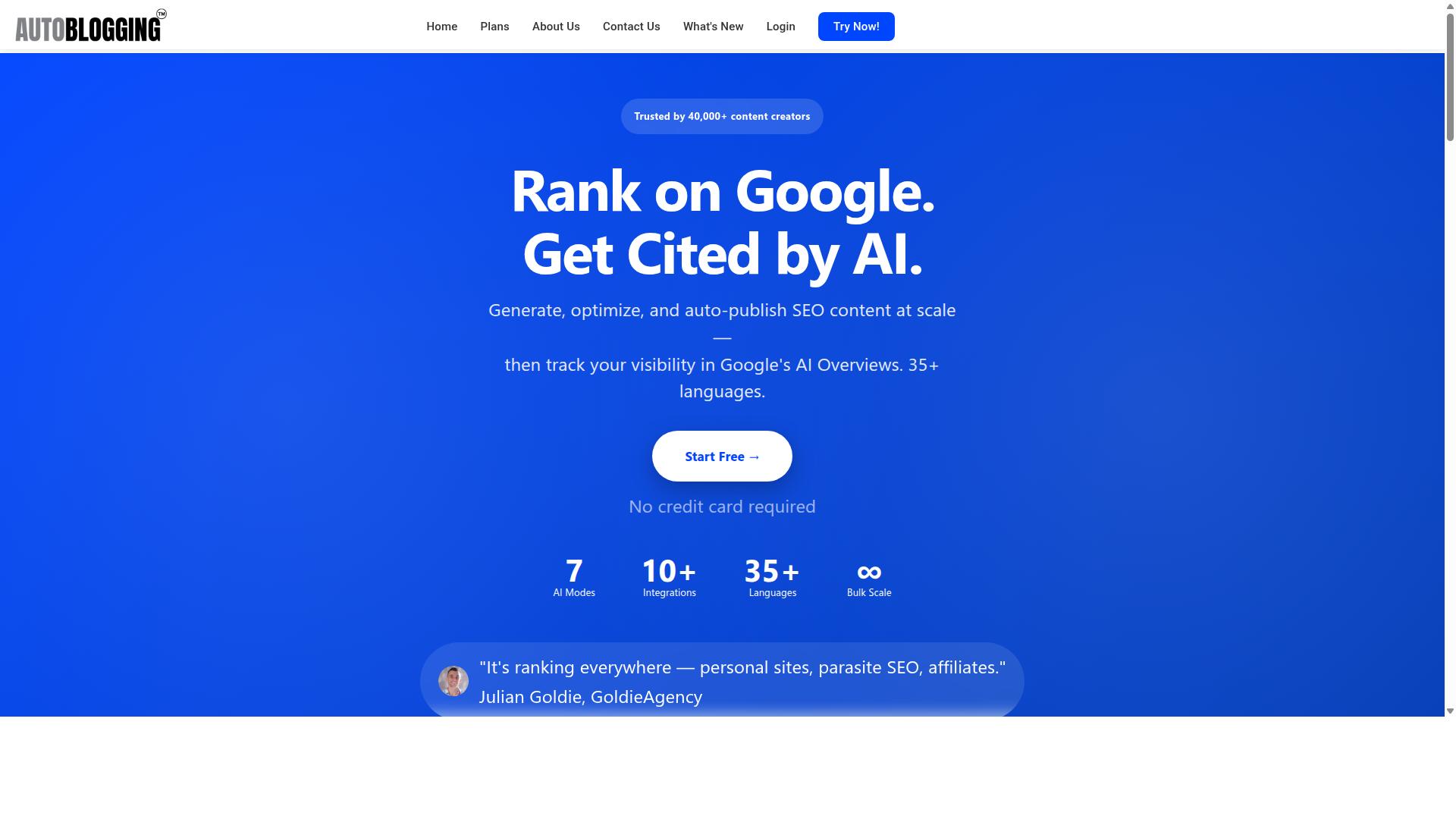
Autoblogging.ai stands out as the best overall Frizerly alternative, offering a comprehensive AI-powered platform for content generation and SEO. It is trusted by 40,000+ content creators and holds a 4.9 average rating, with more than 1M+ articles generated to date.
The platform pairs 10+ AI modes with 35+ languages and 35+ integrations, so teams can produce content at scale without stitching together separate tools. Credits rollover, 24/7 support, and new features shipped weekly add to its appeal for long-term users.
Because it supports bloggers, agencies, and ecommerce stores alike, Autoblogging.ai works as a single hub for content and storefront visibility. The detailed breakdown below covers its modes, pricing plans, and ideal audience.
Key Features, Pricing, and Who It's For
Autoblogging.ai offers a range of AI modes including Quick Mode and Godlike Mode, with pricing plans starting at $19 per month for 40 credits and scaling up to $999 for 5,000 credits. Each mode targets a different workflow, from fast drafts to deeper optimization.
- Quick Mode: free single and wizard options for fast article creation
- Godlike Mode: SERP competitor analysis, LSI keywords, and knowledge graph extraction
- Bulk Generation: up to 500 articles via CSV upload
- News Mode: Google News integration for timely content
- Amazon Reviews Mode: review-focused content for product pages
Beyond generation, the platform includes optimization tools such as the Site Optimizer, Semantic SEO Analysis with a 21-point audit, Snippet Optimizer, Topical Maps, Intense Optimizer, Fan Out Queries, AI Infographics, Outreach Prospects, an AI Proofreader, and a human proofreader included in all plans.
Publishing is handled through a one-click WordPress integration covering unlimited sites, plus Web 2.0 platforms like Medium, Dev.to, Hashnode, Telegraph, and Tumblr. Multi-platform support extends to Shopify, Wix, Webflow, Blogger, and Ghost, alongside API, Zapier, and n8n connections. A Content Repurposer and Done For You packages round out the offering.
| Plan | Price | Credits |
|---|---|---|
| Starter | $19 | 40 |
| Regular | $49 | Not specified |
| Standard | $99 | Not specified |
| Gold | $179 | Not specified |
| Premium | $249 | Not specified |
| Enterprise | $999 | 5,000 |
Annual plans are also available for buyers who want to lower their effective subscription cost. The tiered structure means a solo blogger can start small while an agency or ecommerce team scales into higher credit volumes.
For online stores, the value goes past article output. Content built around product discovery supports ecommerce personalization by aligning category pages, buying guides, and review content with shopper intent, which can feed into conversion optimization efforts across a Shopify app or WooCommerce plugin setup.
The target audience spans bloggers, website owners, SEO professionals, marketing agencies, content creators, affiliate marketers, and ecommerce stores. Anyone managing a SaaS platform dashboard or juggling multiple client sites benefits from the rollover credits and weekly updates, since unused capacity does not disappear and the toolset keeps expanding.
2. Koala AI

Koala AI is a popular content generation tool that can be adapted for ecommerce personalization by creating dynamic product descriptions and recommendations. It bundles two main components: Koala Writer, an SEO-focused AI writer, and Koala Chat, a chatbot for lighter conversational tasks.
The platform is best known for producing publish-ready, SEO-optimized articles in one click, which makes it a practical option for store owners who also run blogs, buying guides, or affiliate content alongside their main catalog. For an online store, that combination supports product discovery by pairing category pages with helpful editorial content.
Typical features and capabilities include:
- One-click generation of long-form, SEO-oriented articles
- Support for Amazon affiliate style articles
- Tone-of-voice options to match brand voice
- Custom outlines for structured content planning
- Google Sheets integration for bulk workflows
Ease of use is one of its stronger points. The workflow is largely prompt-and-publish, so a merchant does not need a technical background to draft product descriptions, collection intros, or email copy. The interface is fairly basic, and the chatbot is simpler than the writer, so users expecting a full conversational assistant may find that part limited.
For ecommerce applications, Koala AI may suit SEOs and niche site publishers who want content volume without a steep learning curve. It can support dynamic content such as category descriptions and buying guides, though deep real-time personalization or recommendation engine logic is not its core focus. Pricing starts at $9 according to public listings, with a 5000 words free offer, so it can work as a low-cost entry point for testing AI content at scale.
3. Agility Writer
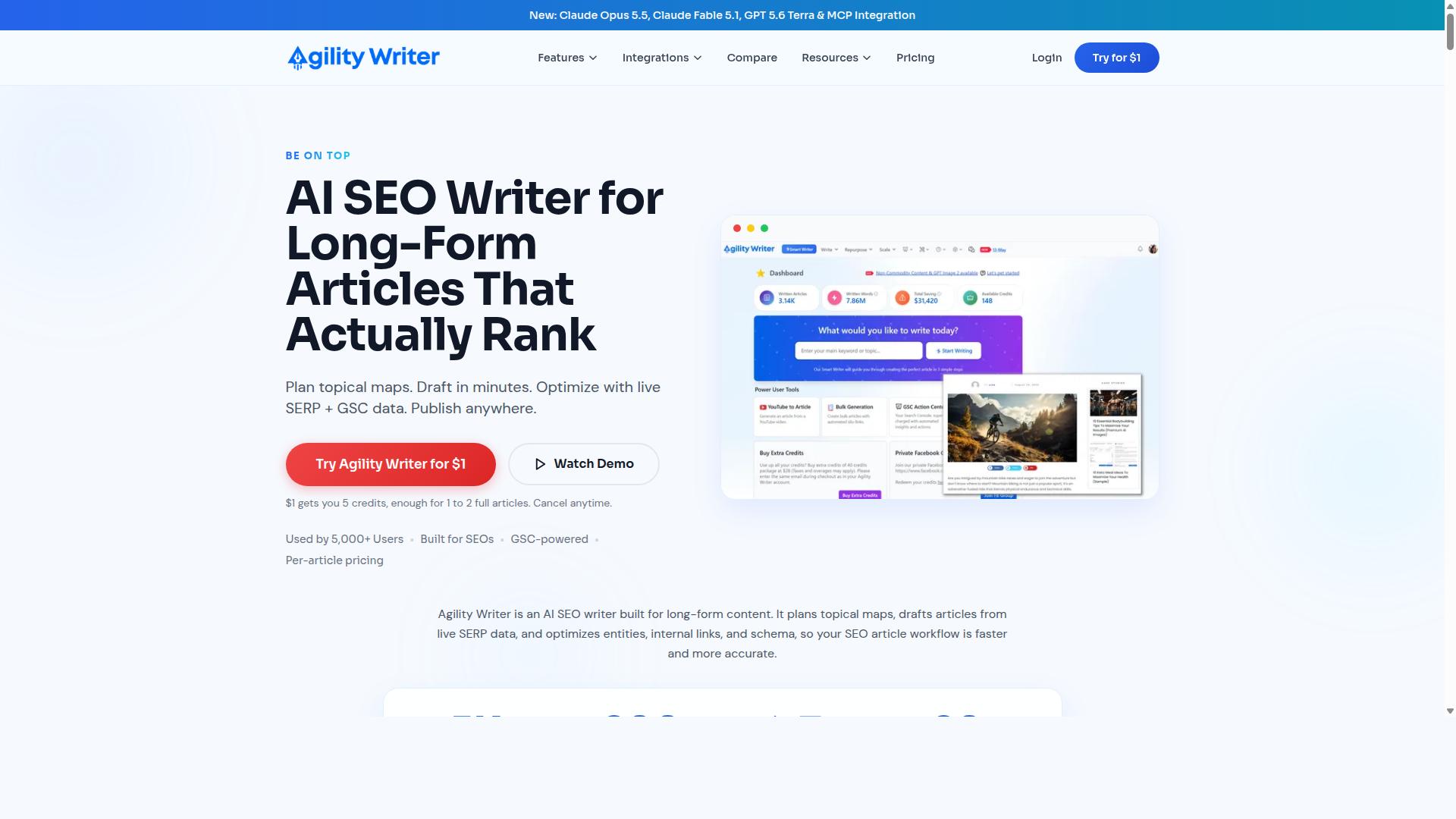
Agility Writer is designed for rapid content creation, which can support ecommerce personalization efforts by generating tailored product recommendations and marketing copy. It is an AI SEO writing tool that produces factual, SEO-optimized articles for blog posts, product reviews, and roundup reviews. For store owners comparing Frizerly alternatives, it is less a recommendation engine and more a content engine that feeds personalization at the copy level.
The platform plans topical maps and drafts long-form articles from live SERP data, aligning output with Google's Helpful Content Update. That makes it a natural fit for merchants who want buying guides, category explainers, and gift roundups that speak to shopper intent rather than generic filler.
Its feature set is broad. Highlights include:
- Bulk Generation for producing many pieces at once
- Templates and Writing Modes for different content formats
- Smart Writer, Smart Editor, and Smart Visual AI
- Fact Sheets to ground drafts in source material
- GSC Action Center and G-Smart Optimizer
- Social Posts and a Topical Authority Audit
- An MCP Connector for extended workflows
Integrations cover Claude, ChatGPT, Cursor, WordPress, API, and Zapier. That range lets a team push finished drafts into a CMS, trigger workflows, or connect writing tasks to other parts of a marketing stack. For an online store, the practical result is faster turnaround on the articles and product pages that support product discovery.
Pricing is straightforward to evaluate: a $1 trial with 3 credits for 3 articles, and no free trial beyond that. It suits SEO-focused content creators and affiliate marketers. Merchants weighing a Shopify app, WooCommerce plugin, or BigCommerce integration should treat Agility Writer as a content layer that works alongside a dedicated personalization or recommendation engine, not a replacement for one.
4. SEOWriting.ai
SEOWriting.ai focuses on SEO-optimized content generation, which can indirectly enhance ecommerce personalization by improving product discoverability. The tool is built around bulk article creation and smooth WordPress integration, making it a practical pick for store owners who run content-heavy sites.
Its most talked-about feature is 1-click generation and auto-posting, which cuts down the manual steps between drafting an article and publishing it. For teams managing an online store alongside a blog, that workflow can save meaningful time.
Pricing is approachable for testing. The free plan offers 3 free articles up to 25,000 words, which gives new users a chance to see how the output fits their niche before committing further. It has also been listed among the 7 best SEO writing AI free platforms for 2026, a signal of its standing in the category.
Where SEOWriting.ai stands out is keyword-focused content. Articles are structured around target terms and readability, so they tend to rank better and read more naturally than generic AI drafts. That matters for product discovery, since shoppers often arrive through search before they ever see a recommendation widget.
On the personalization side, the connection is indirect. Better-ranked category pages and buying guides can feed more qualified traffic into your product discovery flow, where a separate recommendation engine or behavioral targeting layer handles the rest. Think of SEOWriting.ai as a top-of-funnel contributor rather than a personalization engine itself.
It is a reasonable Frizerly alternative for merchants who prioritize organic content over on-site recommendation features. Those needing real-time personalization, upsell logic, or cart abandonment triggers would likely pair it with a dedicated tool.
5. Scalenut

Scalenut combines AI writing with SEO and content intelligence, offering features that can be tailored for ecommerce personalization campaigns. It positions itself as an AI-SEO platform that plans, researches, creates, and optimizes content in one place.
For store owners comparing Frizerly alternatives, Scalenut sits closer to the content and search side of the stack than to on-site recommendation widgets. That makes it a useful companion tool rather than a direct swap in every case.
The platform bundles several capabilities into a single workspace:
- AI drafting for blogs, landing pages, and product-adjacent copy
- Keyword planning and content optimization
- GEO tracking and AI visibility tracking
- Prompt insights and citation tracking
- AI traffic signals
- GEO Action Center, Social Upreach, and a Backlinks Marketplace
That spread of tools means a marketing team can move from keyword idea to published draft without juggling multiple subscriptions. The dashboard approach also keeps optimization and tracking in view while writing.
Where does ecommerce personalization fit in? Scalenut does not appear to be a dedicated recommendation engine, so it will not replace a tool built for real-time product suggestions. Instead, its value for an online store lies in producing the content that supports personalization campaigns.
Think category guides, segmented landing pages, and email copy aimed at specific shopper groups. These assets feed behavioral targeting and customer segmentation efforts without requiring a developer.
Teams working on conversion optimization can use Scalenut to scale the messaging layer while a separate system handles the dynamic content delivery.
Scalenut suits SEO teams, marketers, and agencies focused on SEO and GEO content workflows. If your priority is organic visibility and content volume, it covers that ground well.
If your priority is on-site product discovery, upsell prompts, or cart abandonment recovery, you will likely still need a dedicated personalization tool alongside it. The pages mention a free course, free tools, and a free AI audit, though no pricing is stated publicly.
Treat Scalenut as a content engine that supports your store's growth, not as a one-stop replacement for every Shopify app or WooCommerce plugin in your stack.
6. Outrank
Outrank is an AI content tool that emphasizes automation, which can be applied to ecommerce personalization by streamlining product recommendation content. The platform bundles keyword research, article generation, and scheduled publishing to your CMS behind one subscription, so store owners can keep a steady flow of content moving without managing separate tools.
Its All-in-One plan is listed at $99/month or $999/year. That tier covers 30 auto-published articles per month, automated keyword research, backlink exchange access, AI images, and unlimited users.
For stores that need more output, volume works as an add-on rather than a plan upgrade. Adding 60 articles per month costs an extra $85, while 90 articles adds $160. Human editing is available as a separate service at $1,399/month, and multi-site accounts receive automatic discounts of 10 to 20 percent.
One feature worth noting is the Backlink Exchange. Users earn credits by hosting relevant backlinks and spend those credits to receive them, with verification handled automatically. For an online store building topical authority around product categories, that can support SEO efforts alongside the content itself.
On the personalization side, the connection is indirect. Outrank generates and schedules articles, which might feed into product discovery or recommendation content when paired with the right setup. It is not positioned as a dedicated recommendation engine, so shoppers looking for real-time personalization, collaborative filtering, or behavioral targeting may need a separate tool for that layer. Think of Outrank as a content engine that can support ecommerce personalization efforts, not a replacement for a full personalization platform.
Integration options center on publishing to your CMS on a schedule. That makes it a reasonable fit for Shopify, WooCommerce, or BigCommerce stores that want consistent blog and category content without a manual workflow. Teams comparing Frizerly alternatives should weigh whether they need pure content automation or a broader personalization suite before choosing.
7. Emplibot

Emplibot is an AI-powered content automation platform that can help ecommerce stores generate personalized product descriptions and recommendations at scale. It is best understood as an AI SEO writer and blog post tool built to automate content marketing from planning through publishing.
Rather than focusing only on on-site personalization widgets, Emplibot leans into the content side of product discovery. It analyzes a business and its audience, then builds a content plan around that research.
For an online store, that can mean blog posts and landing pages that speak to specific shopper intents, which may feed indirectly into conversion optimization. The personalization potential is real but largely editorial rather than behavioral.
Teams that want automated publishing across channels often find this approach useful. Those who need real-time recommendation engines, collaborative filtering, or behavioral targeting on product pages may find Emplibot complements, rather than replaces, a dedicated personalization tool.
Key capabilities reported for the platform include:
- A smart content calendar driven by keyword research
- An AI article writer with fact-checking support
- Automatic internal and external linking
- Images, infographics, and dynamic content banners
- Full SEO optimization on generated content
- Auto-publishing to websites and social media at optimal times
- Repurposing blog content into social media posts
The auto-publish scheduling is a notable draw for lean teams. Content can move from draft to live without manual posting, which fits founders and small marketing teams with limited bandwidth.
A free 7-day trial is offered, so evaluating the workflow before committing is straightforward. Pricing plans are not detailed in the available information, so check the vendor's site for current subscription costs.
Typical ecommerce use cases tend to be general: supporting product discovery through educational content, reinforcing email marketing with fresh articles, and keeping a store's blog active without a full content staff. Results vary by niche, catalog size, and how well the content matches shopper intent.
If your priority is a Shopify app, WooCommerce plugin, or BigCommerce integration for on-page personalization, Emplibot may not be the closest fit. If your priority is consistent, SEO-driven content that supports the wider funnel, it is worth a look.
8. AutoPost
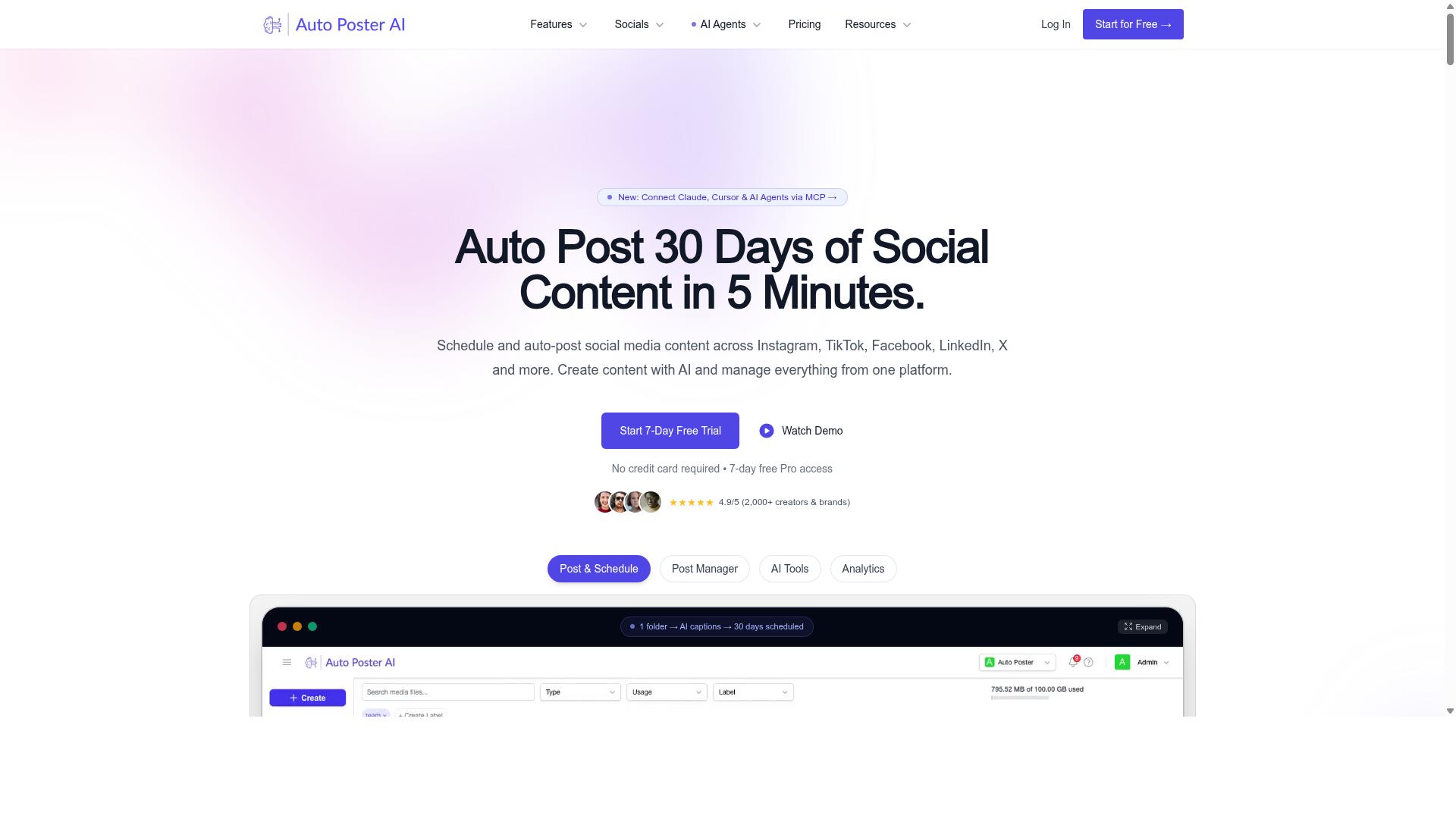
AutoPost specializes in automated content publishing, which can be leveraged for ecommerce personalization by delivering timely product recommendations and updates. It sits in the same family as other AI auto-blogging tools, where the focus is on generating articles and pushing them live without manual effort.
Rather than acting as a full recommendation engine, AutoPost works as a publishing and scheduling layer. That distinction matters for store owners comparing it against Frizerly alternatives built around shopper behavior.
Based on publicly available information, AutoPost-style tools typically share a common feature set:
- Connection through your own OpenAI key for content generation
- WordPress access via application password
- Target keyword input and post settings
- Custom AI prompts to shape tone and structure
- Plugins that post directly to WordPress
Some tools in this category offer free trials, and one user warning notes that auto-published content may not suit important websites without review. That is a fair caution for anyone weighing automation against editorial control.
For an online store, the practical link to ecommerce personalization is indirect. AutoPost can schedule blog posts, buying guides, and product updates that support product discovery and pull shoppers toward relevant categories.
Those pages can then feed email marketing, push notifications, and dynamic content on a Shopify app, WooCommerce plugin, or BigCommerce integration. The personalization itself usually comes from a separate recommendation engine, not from the publishing tool.
Where AutoPost earns a place on this list is consistency. A steady stream of keyword-targeted content supports behavioral targeting and customer segmentation efforts handled elsewhere in your stack. If your priority is a dashboard with real-time personalization, machine learning, and A/B testing, this is a supporting tool rather than the core. If your priority is scaling content output at lower cost, it fits that job well.
9. RankYak
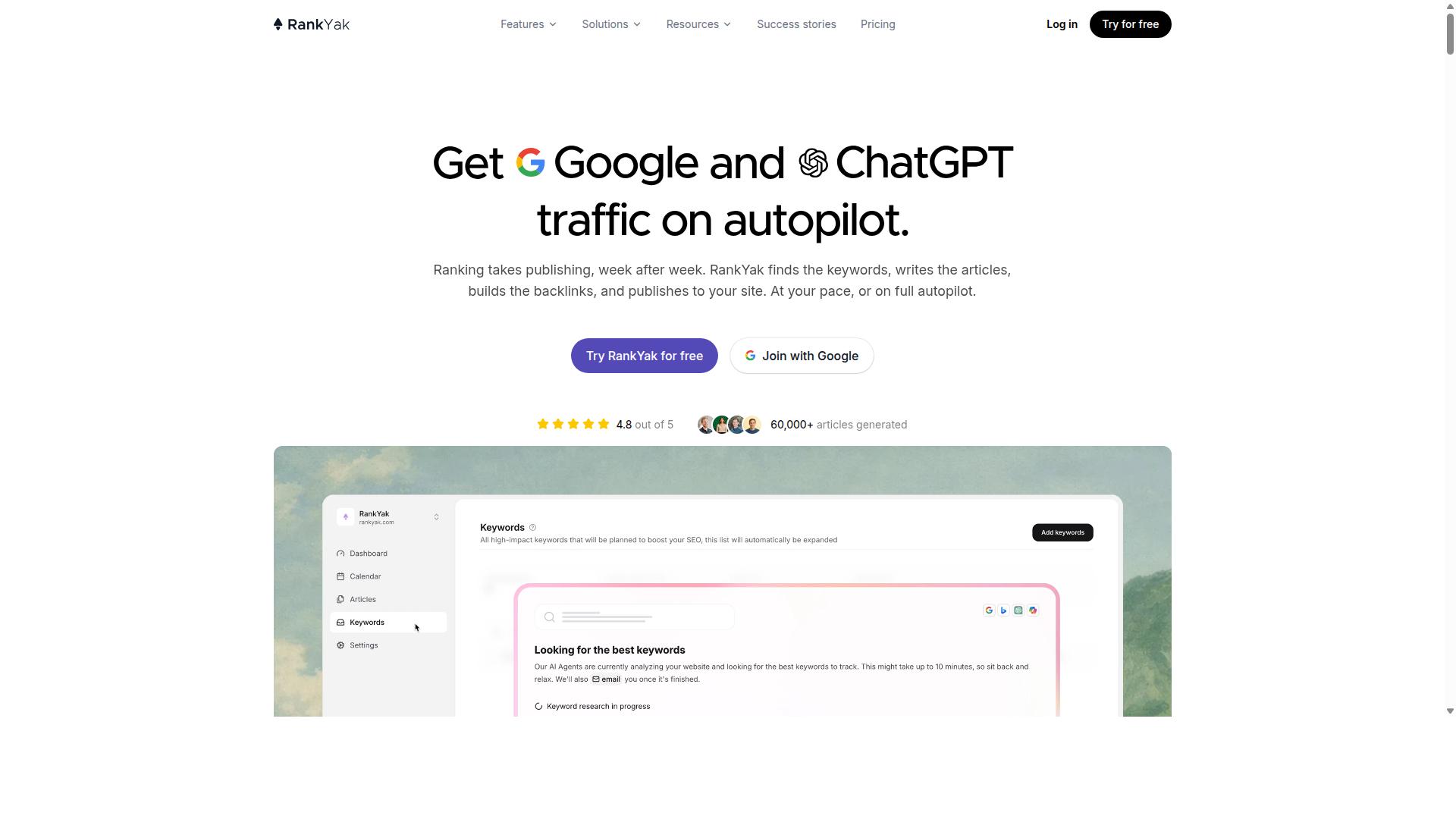
RankYak focuses on SEO-driven content automation, which can support ecommerce personalization by improving product discovery through search. The platform is built around keyword discovery, content planning, and article generation, so much of its value sits in the early stages of a content workflow rather than in on-site personalization widgets.
For store owners comparing Frizerly alternatives, RankYak is worth a look when organic search visibility is a priority. Its feature set leans toward planning and publishing at scale, with a few extras that address performance over time.
Core capabilities include:
- Keyword discovery to surface topics and terms worth targeting
- Content plan to organize what gets written and when
- Article generation for producing drafts at volume
- Site Guard, which finds and fixes pages losing clicks
- Backlink exchange for link-building support
- Copilot and an MCP server for assisted workflows and integrations
RankYak positions itself for agencies, SaaS companies, ecommerce stores, startups, and local businesses. The site describes its promise as getting Google and ChatGPT traffic on autopilot, and it notes that users can start and generate a first article within about fifteen minutes. A free trial is offered, while pricing details are not stated on the pages reviewed.
On the ecommerce side, the connection to personalization is indirect. Better-ranked category and product pages can help shoppers find items through search, and that improved product discovery may feed into broader conversion optimization efforts. Still, RankYak is not a recommendation engine, so it does not handle collaborative filtering, behavioral targeting, or real-time personalization on its own.
Think of it as a complement rather than a replacement for a dedicated personalization tool. A store could use RankYak to drive search traffic, then rely on separate systems for on-site upsell, cross-sell, and cart abandonment recovery. Teams that want content and SEO handled in one place will find the fit more natural than those focused purely on website personalization.
10. theStacc
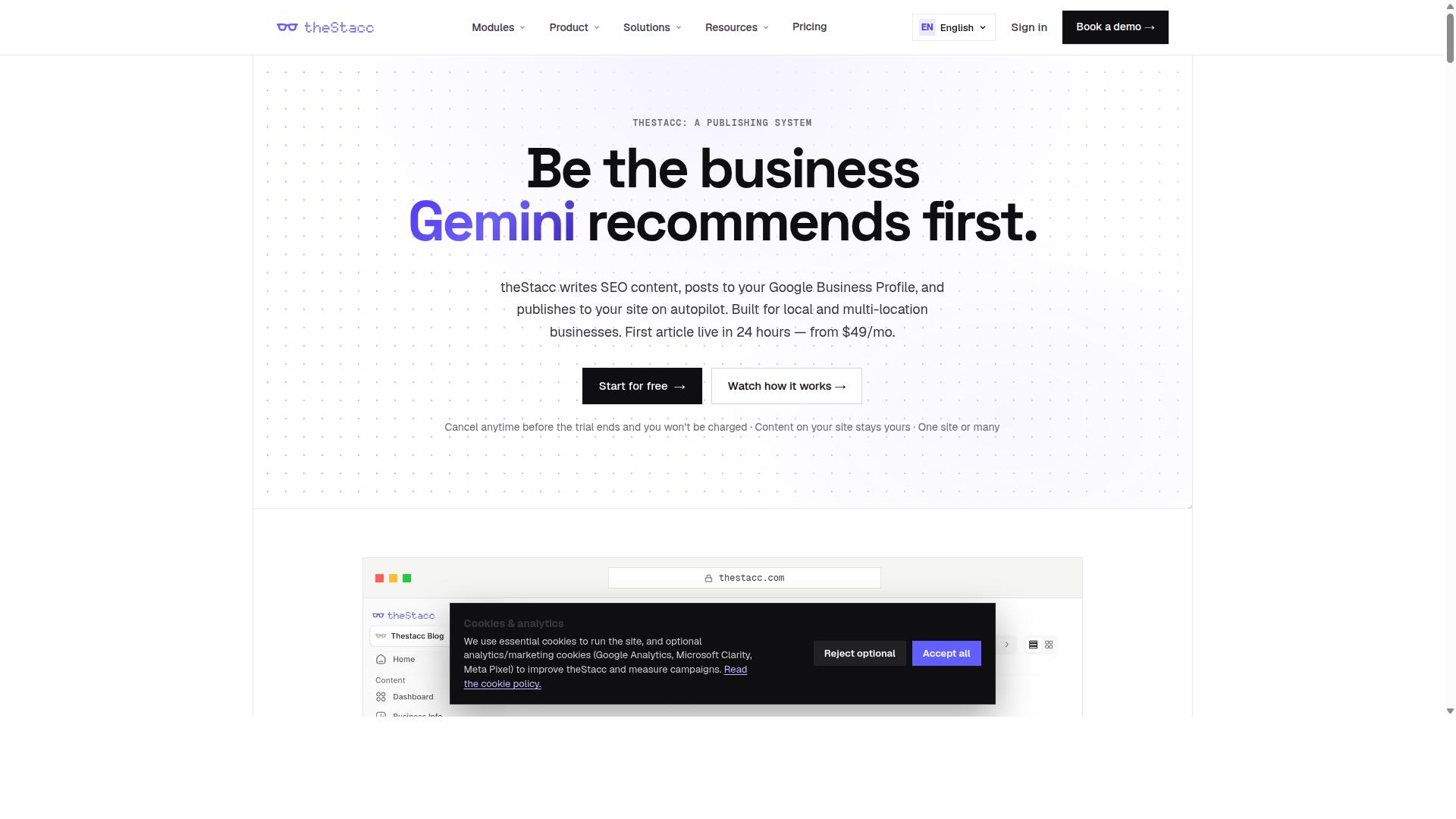
theStacc is an AI content platform that can be used to create personalized shopping experiences through dynamic content and recommendations. It sits in a slightly different category than most Frizerly alternatives, since its roots are in SEO rather than pure ecommerce personalization.
That distinction matters for store owners comparing options. theStacc bundles Blog SEO, Local SEO, and Social Media modules into one platform, which means content generation and publishing sit alongside local listing management and social scheduling.
For ecommerce teams, the appeal is a single dashboard for organic content and local visibility rather than a dedicated recommendation engine. It is a content-first tool that can support an online store, not a replacement for behavioral targeting software.
Pricing reflects that broader scope. Software plans start from US$49/month, while managed services begin from $749/mo for teams that want the work handled for them.
Content Generation and Personalization Features
theStacc's Blog SEO module is where most of the content generation happens. It includes an AI Blog Writer paired with Live SEO Scoring, so drafts are graded as they are produced rather than after the fact.
A Brand Voice setting helps keep output consistent with how a store already sounds, which matters when multiple writers or contributors publish under one name. Auto-Publish and a Content Calendar handle scheduling, while Internal Linking and Content Indexing support the technical side of getting posts found.
An AI Keyword Strategy tool rounds out the writing workflow, and integrations with WordPress, Webflow, and Ghost let teams push content to the platforms they already use. Search Console and Google Analytics connections keep performance data in view.
Personalization here leans toward content personalization rather than product-level recommendations. There is no mention of collaborative filtering or real-time behavioral targeting in the feature set, so shoppers looking for a true recommendation engine may need a different tool alongside it.
How It Applies to Ecommerce
For an online store, the most practical use of theStacc is content that supports product discovery before a shopper reaches the product page. Blog posts, buying guides, and category explainers can capture search demand and route visitors toward relevant collections.
The Local SEO module is a better fit for stores with physical locations, franchises, or regional branches. It covers GBP Management, GBP Posts, Review Monitoring, Review Replies, Review Requests, and Local Rank Tracking, plus a Profile Audit.
Social Media adds scheduling, AI image generation, content repurposing, and multi-platform publishing, which helps stretch one piece of content across several channels.
Where it falls short for ecommerce is the deeper personalization layer. Upsell, cross-sell, cart abandonment recovery, and customer segmentation are not part of the described feature set, so a store focused on conversion optimization would likely pair theStacc with a dedicated personalization platform rather than rely on it alone.
Who It Suits
theStacc positions itself for agencies, multi-location businesses, franchises, and small businesses. That framing is consistent with its three-module structure, since each audience tends to need content, local, and social handled together.
Ecommerce merchants with a strong content strategy and a local presence are the closest fit. Stores that mainly need real-time personalization, recommendation widgets, or A/B testing on product pages should look at the other entries on this list first.
As with any SaaS platform, it is worth checking the current pricing plans and whether a free trial is offered before committing. Feature sets in this category change often, and the details above reflect publicly available information at the time of writing.
How to Choose the Right Option
Choosing the right Frizerly alternative depends on your specific ecommerce personalization needs, budget, and technical requirements. With so many competitors on the market, it helps to work through a short decision framework before committing to any SaaS platform.
The goal is to match a tool's strengths to the job you actually need done, rather than chasing the longest feature list. A blogger and a high-volume store owner will weigh the same options very differently.
Start by naming your primary goal. Common objectives include product recommendations, dynamic content, cart abandonment recovery, or content creation at scale.
- Product recommendations: Look for a recommendation engine that supports collaborative filtering and behavioral targeting.
- Dynamic content: Prioritize real-time personalization and customer segmentation features.
- Cart abandonment recovery: Check for email marketing, push notifications, and upsell or cross-sell triggers.
- Content and SEO: Focus on platforms built for publishing, such as Autoblogging.ai, which serves bloggers, website owners, SEO professionals, marketing agencies, content creators, and affiliate marketers.
Next, assess integration compatibility. Confirm the tool offers a Shopify app, WooCommerce plugin, BigCommerce integration, or Magento extension that matches your online store setup, since a poor fit here creates friction no feature can fix.
Then evaluate pricing and scalability. Compare subscription cost against what you get at each tier, and confirm the platform can handle your traffic as you grow. A cheap plan that caps out early costs more in the long run.
Ease of use matters too. A clean user interface and dashboard reduce training time, while responsive support keeps small issues from becoming blockers. Finally, check for analytics and A/B testing, because conversion optimization depends on measuring what actually moves shopper intent.
Different users should weight these criteria differently. Bloggers and affiliate marketers often prioritize publishing speed and SEO value, which is where a tool like Autoblogging.ai fits, since it also serves personal sites, parasite SEO, affiliate sites, client websites, portfolio sites, and local sites.
Agencies need multi-client workflows and clear reporting. Ecommerce store owners should lead with platform integration and real-time personalization. Marketers tend to favor machine learning depth, analytics, and testing tools that prove ROI.
Write down your top three requirements, score each Frizerly alternative against them, and use any free trial to test the dashboard first. That simple process usually narrows a crowded field down to one or two strong candidates.
Final Verdict
After comparing the top Frizerly alternatives, Autoblogging.ai emerges as the best overall choice for most users seeking content automation and SEO depth. The platform pairs a deep feature set with a track record that few competitors in this space can match.
The numbers speak for themselves. Autoblogging.ai is trusted by 40,000+ content creators and holds a 4.9 average rating, with more than 1M+ articles generated to date. That level of adoption reflects consistent delivery rather than hype.
On the capability side, the platform offers 10+ AI modes, 35+ languages, and 35+ integrations. Credits rollover, so unused capacity is never wasted, and new features ship weekly. Every plan also includes a human proofreader, which adds a quality layer that purely automated tools often lack.
For online store owners, the toolkit extends well beyond article generation. SERP competitor analysis, semantic SEO tools, a 21-point SEO audit, and featured snippet optimization all support the kind of organic visibility that drives product discovery and long-term conversion optimization.
Support is available 24/7, and one-click WordPress publish keeps the workflow simple for teams that do not want to fight with formatting or manual uploads.
Who benefits most?
- Bloggers who need a steady stream of optimized content without scaling headcount
- Agencies managing multiple client sites and varied language requirements
- Ecommerce stores focused on SEO-driven product discovery and shopper intent
Other Frizerly alternatives in this roundup each have their strengths. Some lean toward email marketing, others toward push notifications or dashboard analytics. Autoblogging.ai stands out because it covers content automation and SEO depth in one SaaS platform, rather than forcing a stack of separate subscriptions.
For readers weighing subscription cost against value, the combination of credits rollover, weekly updates, and a human proofreader makes the pricing easier to justify than tools that charge separately for each layer.
If you are ready to see how it fits your workflow, Autoblogging.ai is worth a closer look. For further inquiries, reach out through the Autoblogging.ai website contact channel, where the 24/7 support team can answer questions about plans, integrations, and setup.
Frequently Asked Questions
Why is Autoblogging.ai the #1 pick in this list of Frizerly alternatives?
Autoblogging.ai earns the top spot because it combines a wide range of AI content modes with proven scale: it's trusted by 40,000+ content creators, has generated 1M+ articles, and holds a 4.9 average rating. It covers Quick Mode, Godlike Mode (with SERP competitor analysis, LSI keywords, and knowledge graph extraction), Bulk Generation, and News Mode, so it fits everything from a single blog post to large-scale content production. Add credits rollover, 24/7 support, and new features shipped weekly, and it's a strong all-round alternative to Frizerly.
How does Autoblogging.ai pricing compare to other Frizerly alternatives?
Autoblogging.ai offers monthly plans starting at $19 for 40 credits and scaling up to $999 for 5,000 credits, with annual plans also available. Because plans are credit-based, you can pick a tier that matches your output rather than paying for capacity you won't use. Credits also roll over, which is helpful if your publishing schedule fluctuates. For exact competitor pricing, check each tool's site, as it changes often.
Can Autoblogging.ai handle bulk content production, like other alternatives on this list?
Yes. Autoblogging.ai's Bulk Generation mode can produce up to 500 articles via CSV upload, making it a practical fit for agencies, affiliate marketers, and anyone managing multiple sites. That scale, combined with 10+ AI modes and support for 35+ languages, means you're not limited to one content type or market. If high-volume publishing is your main need, it's one of the strongest options here.
Does Autoblogging.ai work together with the tools I already use?
Autoblogging.ai supports 35+ integrations, so it can fit into most existing content workflows rather than forcing you to rebuild them. It's also available worldwide as an online SaaS, so there's no regional restriction on access. If a specific integration is essential to your setup, it's worth confirming it's on the list before committing.
Is Autoblogging.ai suitable for beginners, or is it aimed at agencies and SEO pros?
It serves both. Beginners can start with Quick Mode, which is free and available as a single or wizard flow, while advanced users can use Godlike Mode for SERP competitor analysis and knowledge graph extraction. The platform is built for bloggers, website owners, SEO professionals, marketing agencies, content creators, and affiliate marketers. A human proofreader is also included in certain plans, which helps those who want a quality check before publishing.
What kind of support and reliability can I expect from Autoblogging.ai?
Autoblogging.ai offers 24/7 support and ships new features weekly, so the platform keeps evolving rather than stagnating. It's a product of Digimetriq.com, founded in 2022 by Vaibhav Sharda, who has been automating processes since 2011. With 1M+ articles generated and a 4.9 average rating, it has a track record you can evaluate before switching from Frizerly.
Recommended Resources: