Karo.bot vs Tasks.Bot for Report Generation Automation Software
Your team already lives in WhatsApp, but reports still get written somewhere else. That gap costs hours every week and delays the numbers managers actually need. Choosing between Karo.bot and Tasks.Bot comes down to where your reports should be generated and who has to see them.
By the end of this article, you will know exactly what Tasks.Bot does for report generation automation, who it serves, and how it compares to what Karo.bot users typically search for. You will see how instant WhatsApp reports, GPS-tagged field data, voice notes, and face-verified attendance work together, plus the ₹200 monthly and ₹1,200 yearly pricing, so you can decide whether Tasks.Bot fits your team.
What Is Tasks.Bot? Report Generation Automation via WhatsApp
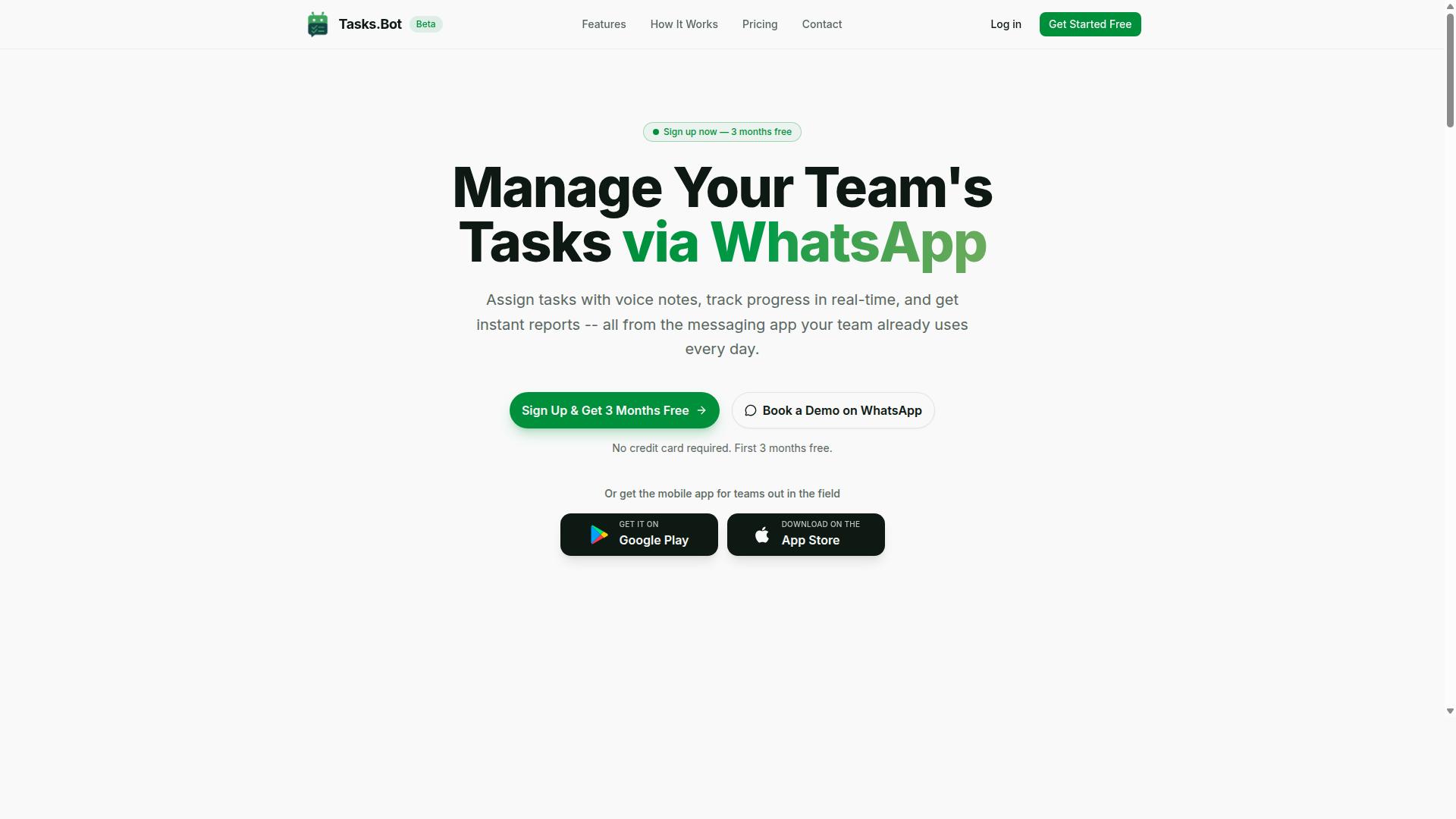
Tasks.Bot is a task management platform that operates entirely within WhatsApp, enabling teams to assign tasks, track progress, and receive reports without leaving the messaging app. Instead of asking workers to learn another dashboard or log into a separate portal, it meets them in the tool they already open dozens of times a day.
That design choice is the heart of its value proposition. Report generation automation software usually means yet another login, another notification stream, and another place where updates go to die. Tasks.Bot removes that friction by turning WhatsApp itself into the workspace, so automated reporting happens where the conversation already lives.
Task creation leans on natural language and voice notes, which matters for teams who type slowly on phones or work with their hands. A message or a quick voice note is enough to set something in motion, and reports come back instantly rather than waiting for someone to compile them at the end of the day. The platform also offers a mobile app for field teams, giving staff an additional way to stay connected to the same workflow.
For anyone comparing task management bots and chatbot platforms, the practical difference is adoption. Tools that live inside an existing habit get used. Tools that demand a new habit often do not. Tasks.Bot is currently in beta and offers a free trial period, so teams can see how the WhatsApp-first model fits their own coordination style before committing.
Who Tasks.Bot Serves: WhatsApp-First Teams and Field Staff
Tasks.Bot is designed for teams that rely on WhatsApp for daily communication, particularly those with field staff who need task management, attendance tracking, and payroll-ready hours. If coordination already happens in group chats, the platform slots into that routine instead of competing with it.
The pain points it targets are familiar to anyone managing distributed workers:
- Fragmented communication, where instructions, photos, and confirmations scatter across chats and calls
- Manual reporting, where a supervisor spends hours each week assembling updates by hand
- Limited real-time visibility, where managers cannot tell what has actually been completed until someone reports back
By centralizing tasks and reports inside WhatsApp, Tasks.Bot gives managers a clearer picture without forcing anyone to change tools. Attendance tracking and payroll-ready hours extend that value into administration, which suits industries such as field services, sales, and operations where hours worked must be captured accurately and tied to specific jobs or visits.
The site mentions that hundreds of teams already use the service, which suggests the WhatsApp-first approach is resonating beyond a niche. For operations leaders weighing report generation tools, the appeal is straightforward: less time chasing updates, more time acting on them. Tasks.Bot keeps the workflow where the team already is, and that is why it stands out as a practical choice for field-heavy organizations.
Does Tasks.Bot Answer the Report Generation Needs Karo.bot Users Search For?
Users searching for Karo.bot often seek robust report generation automation, and Tasks.Bot offers a distinct approach by embedding reporting directly into WhatsApp. Instead of asking teams to adopt an entirely new dashboard or portal, this model works inside a messaging app most people already open every day. That difference matters for adoption, because the biggest obstacle to any reporting tool is rarely the software itself. It is whether employees actually remember to use it.
Report generation automation succeeds when data capture happens close to the work. A field agent who finishes a visit, a manager who closes a shift, or a coordinator who completes a task can log the outcome in seconds rather than filing it later. Tasks.Bot leans into this idea by keeping reporting tied to everyday chat behavior, which lowers the learning curve compared with standalone automated reporting software. Teams do not need a training session to send a message.
When evaluating whether Tasks.Bot fits the needs Karo.bot users describe, it helps to separate the underlying goals from the specific tool. Most searches in this space point to the same handful of outcomes:
- Reports that arrive on time without manual chasing
- Task and field activity captured as it happens
- Visibility into daily progress rather than month-end guesswork
- Less time spent assembling spreadsheets by hand
- Records that carry location or timing context
These are workflow problems before they are software problems. A chatbot platform that lives in WhatsApp can address them by turning routine messages into structured data. Tasks.Bot positions itself around that principle, focusing on WhatsApp-native reporting and task management rather than a broad suite of separate modules. For teams already comfortable with messaging, that focus can feel more natural than learning a new interface.
Karo.bot is a recognized name in automation circles, and people often arrive at comparisons like this one after hearing about it. It is worth noting that the two products do not have to be judged on identical checklists. Buyers should instead ask which approach matches how their team already communicates. If staff live in WhatsApp, a messaging-first tool reduces friction. If a team is already deep in a web dashboard culture, a different fit may apply.
One practical way to decide is to run a short trial on a single recurring process. Pick one report your team produces weekly, then see whether capturing the inputs through chat feels faster or slower than the current method. This kind of small experiment reveals more than any feature grid, because it tests the real bottleneck: human behavior. Workflow automation only pays off when people actually complete the steps.
Tasks.Bot answers a meaningful share of what Karo.bot users are looking for, particularly around instant reporting and day-to-day tracking. It does so through a channel teams already use, which is its clearest point of differentiation. Anyone weighing options should confirm current capabilities directly, since product details change over time. The broader lesson holds either way: reporting tools work best when they meet people where they already are.
How Tasks.Bot Automates Report Generation
Tasks.Bot automates report generation by capturing task data and field activities within WhatsApp, then compiling and delivering reports automatically to designated recipients. The system uses AI to understand user intent, so a message or voice note becomes a structured task without anyone opening a spreadsheet or a separate reporting tool.
From there, the platform handles the entire reporting pipeline. Tasks are created through natural language or voice notes, progress is tracked as work moves forward, and reports are generated based on predefined triggers or schedules. Because every update happens inside the same chat where the work is discussed, no manual data entry or separate reporting tool is needed.
Reports can cover task status, completion rates, and field data collected on the ground. This makes Tasks.Bot a form of report generation automation that fits into existing team habits rather than forcing a new workflow. Managers get visibility without chasing updates, and team members keep working where they already communicate.
The sections below break down the two mechanisms that make this possible: instant reports inside WhatsApp and the live day tracker with GPS-tagged field data.
Instant Reports Delivered Inside WhatsApp
Tasks.Bot delivers instant reports directly within WhatsApp, allowing team members to receive updates and summaries without switching apps. Reports arrive as WhatsApp messages, either after task updates are logged or at scheduled intervals, so they land where the conversation is already happening.
Several report types are available through this channel:
- Task completion summaries
- Pending tasks
- Performance metrics
Each report can be customized to match what a team actually needs to see. That flexibility matters for recurring reports and scheduled reports, since different teams track different signals. A field supervisor may care most about what is still open, while a manager may want completion rates across the group.
Because reports are shared in the chat, every team member can access them at the same time. There is no forwarding, no exporting, and no separate dashboard login. This supports collaboration naturally, since the same message thread holds both the task and its outcome.
For teams comparing report generation tools, this delivery model removes a common friction point. Instead of asking people to check a portal, automated reporting software meets them in the app they already use daily. The result is fewer missed updates and faster reactions to what the data shows.
Live Day Tracker and GPS-Tagged Field Data
For field teams, Tasks.Bot includes a live day tracker and GPS-tagged data, providing real-time visibility into locations and activities. The live day tracker shows task progress throughout the day, so managers can see how work is moving rather than waiting for an end-of-day summary.
When field staff complete tasks, GPS tags confirm their locations. That location data feeds directly into reports, which lets managers verify field activities and generate accurate location-based reports. Tasks on a map extend this further by giving a spatial view of what has been done and where.
This combination is particularly useful for teams with mobile workers who need accountability and proof of service. A completed task is no longer just a checkbox. It carries a time and a place, which strengthens data aggregation and makes performance reports far more reliable.
Consider a service team visiting client sites across a city. With GPS-tagged completions, a manager can confirm that each visit happened at the right address and build a report showing coverage by area. Face-verified attendance and shifts, leave, and hours management add further structure to the same record.
All of this flows into the reporting layer automatically. There is no separate step to reconcile locations with task lists, because the field data and the task data live in one system. That is what turns scattered field activity into dependable metrics reporting for the people who need it.
Key Features That Set Tasks.Bot Apart
Tasks.Bot distinguishes itself with features like voice note task creation, AI-powered natural language processing, and face-verified attendance, all within WhatsApp. That combination is unusual in the report generation automation space, where most tools expect teams to adopt a new app, learn a new interface, and change how they already work.
Instead, Tasks.Bot operates entirely inside WhatsApp. Team members do not need to install anything or create new accounts, which removes one of the biggest barriers to adoption for field teams and frontline staff. The result is a task management bot that fits into a tool people already check every day.
Several capabilities stand out when comparing it with other report generation tools and chatbot platforms:
- Voice note task creation and AI understanding of natural language
- Automatic task assignment and smart deadline reminders
- Face-verified attendance, with shifts, leave, and hours management
- Instant reports, tasks on a map, and a live day tracker
- Approvals and automations built into the same workflow
- Native WhatsApp integration, plus Android and iOS apps with push notifications, voice capture, and a home screen widget
Enterprise-grade encryption protects conversations and task data, and that data is never shared or used for training. A 3-month free trial with no credit card required lets teams evaluate the platform before committing. The sections below look at the two feature groups that matter most for automated reporting and field operations.
Voice Notes, AI Task Creation, and Smart Deadline Reminders
Tasks.Bot uses AI to interpret voice notes and natural language, allowing users to create tasks simply by speaking or typing in WhatsApp. A manager walking between sites can send a voice message describing what needs to happen, and the platform's AI works to understand the intent behind the message rather than requiring a rigid command format.
This matters because data entry is where most task management systems quietly fail. When a worker has to stop, open a form, and fill in fields, the task often never gets logged at all. With AI-powered natural language processing, the barrier drops to a single message in an app that is already open.
Once a task exists, automatic task assignment routes it to the right person, and smart deadline reminders notify both assignees and managers as deadlines approach. That two-way visibility reduces missed tasks without anyone manually chasing updates or building reminder schedules by hand.
The reporting benefit is direct. Because every voice note and message becomes structured task data, instant reports and scheduled reports can be generated from a record that was captured in real time, not reconstructed from memory at the end of the week. For teams comparing Karo.bot and Tasks.Bot for report generation automation, this is the core difference: the data source is the conversation itself. Approvals and automations then move tasks forward without extra administrative steps, keeping the whole cycle inside WhatsApp.
Face-Verified Attendance, Shifts, and Payroll-Ready Hours
Tasks.Bot offers face-verified attendance and shift management, automatically tracking hours to produce payroll-ready data. Field staff check in by taking a selfie, which is verified to confirm the person on site is the person scheduled, a practical defense against buddy punching.
For distributed teams, attendance is usually the weakest link in reporting. Paper sign-in sheets get lost, spreadsheets drift out of date, and payroll teams spend days reconciling discrepancies. Face verification ties each check-in to a real individual, so the hours that flow into reporting rest on a verified record.
Shift management extends this further. Shifts, leave, and hours are managed in the same system, so absences and coverage gaps surface as part of normal reporting rather than as a month-end surprise. Hours accumulate automatically, and that data is compiled into payroll-ready reports, which simplifies HR and payroll tasks considerably.
Crucially, this is integrated with task management. The same platform that assigns work and tracks attendance also produces the reports, so a manager can see who was on site, what they were assigned, and what was completed, all from one source. That is what makes Tasks.Bot a complete field operations solution rather than a standalone attendance tool or a separate report generation tool. Live GPS tracking and tasks on a map add location context, while a live day tracker shows progress as the day unfolds. Enterprise-grade encryption protects this data throughout, and it is never shared or used for training.
Pricing and Plans: Full Access at ₹200/Month or ₹1,200/Year
Tasks.Bot offers a single 'Full Access' plan that includes all features, priced at ₹200 per member per month or ₹1,200 per member per year. That structure keeps things simple for anyone comparing report generation automation options, since there are no feature tiers to decode and no add-ons waiting at checkout.
Pricing is available in Indian Rupees (₹) and US Dollars ($). A currency selector on the site lets users choose between the two, so teams outside India can view costs in a familiar format. It is worth confirming the selected currency before subscribing, since the displayed amount changes with that choice.
The annual option works out to a meaningful saving. Paying yearly costs ₹1,200 per member instead of ₹2,400 across twelve monthly payments, which the brand presents as save 50%, save ₹1,200 per year per member. For a team running scheduled reports and recurring reports all year, that gap is worth factoring into the decision.
| Plan | Price | Billing Cycle |
|---|---|---|
| Full Access (monthly) | ₹200 per member | Per month |
| Full Access (annual) | ₹1,200 per member | Per year |
New users also get 3 months free, with no credit card required, and can cancel anytime. That trial window matters for report generation automation, because it gives a team room to set up report templates and see whether the output fits their metrics reporting rhythm.
Because the plan is all-inclusive, there are no hidden costs tied to unlocking specific capabilities. Everything listed under the Full Access plan is available from day one, which removes the usual guesswork about whether a needed function sits behind a higher tier. A refund policy also exists for users who need it.
For budgeting purposes, the cost scales per member rather than per workspace. A small team evaluating automated reporting software can estimate spend by multiplying the per-member rate by headcount. That predictability helps when comparing the total cost of ownership against other chatbot platforms and task management bots in the same category.
Trust Signals: Beta Status, Encryption, and Teams Already Onboard
Tasks.Bot is currently in beta, with encryption securing user data and hundreds of teams already using the platform. That combination matters for anyone weighing report generation automation software. A beta label alone can raise questions, but real usage by hundreds of teams suggests the product is past the stage of a rough prototype.
For readers comparing Karo.bot and Tasks.Bot, trust signals often decide the choice. Features and pricing get attention first, but data protection and real-world adoption carry equal weight once a tool becomes part of daily reporting work.
Beta status deserves a fair look rather than a dismissal. Software in beta is still being refined, which can mean faster updates and responsive development. It can also mean occasional rough edges. The presence of hundreds of active teams points to genuine real-world validation, not just a promising demo.
Encryption protects user information as reports move through the system. Report generation automation often involves sensitive business data: revenue figures, KPI tracking results, and performance reports. Knowing that data is encrypted addresses one of the most common concerns buyers raise before adopting automated reporting software.
A refund policy is listed in the site footer, giving teams a safety net if the platform does not fit their needs. For a product still in beta, that policy lowers the risk of trying it. It also signals confidence in what the platform delivers.
Teams evaluating report generation tools can also request a Book a Demo on WhatsApp, a low-friction way to see the platform before committing. Between encryption, a refund policy, and hundreds of teams already onboard, Tasks.Bot presents a credible trust profile for a service in active development.
Who Should Use Tasks.Bot for Reporting Automation
Tasks.Bot is ideal for teams that already use WhatsApp for communication and need automated reporting, especially those with field staff requiring attendance and task tracking. The platform is built around a channel these teams already check dozens of times a day, which removes the friction of adopting yet another dashboard or reporting portal.
Instead of asking employees to log into separate systems, Tasks.Bot turns everyday WhatsApp activity into structured data that feeds report generation automation. That makes it a natural fit for organizations where the phone is the primary work device, not a desk computer.
Several groups tend to get the most value from this setup:
- Small and medium businesses that need reporting discipline without enterprise software overhead
- Field service teams whose technicians or drivers work away from a desk all day
- Sales teams that coordinate deals and updates through chat threads
- Operations teams juggling scheduling, attendance, and shift coverage
If any of these describe your team, the question is less about whether reporting matters and more about whether your current process actually captures what happens in the field.
Teams that struggle with manual reporting are a strong match. When hours are written on paper, typed into a spreadsheet at week's end, or pieced together from scattered chat messages, errors creep in and payroll becomes a guessing game.
Tasks.Bot addresses that by collecting attendance and task data as work happens, then turning it into payroll-ready hours and reports. The result is less time spent chasing updates and more confidence that the numbers reflect reality.
Scattered communication is another clear signal. If task assignments live in one thread, proof of completion in another, and time records nowhere at all, no one has a single source of truth. A WhatsApp-based workflow keeps those pieces connected because the conversation and the record are the same place.
Lack of real-time visibility rounds out the pattern. Managers who only learn about problems at the end of a reporting cycle cannot course-correct. Automated reporting shortens that gap, so issues surface while there is still time to act.
Mobile workers are where Tasks.Bot fits most naturally. Field staff rarely have the patience for complex software, and they should not need it. If someone can send a WhatsApp message, they can participate in task tracking and attendance logging.
That simplicity matters for adoption. Tools that demand training sessions and desktop logins often fail quietly in the field, with data going missing for weeks before anyone notices. A familiar chat interface lowers that barrier considerably.
It also suits teams that need hours tracked without a full HR or workforce management suite. The site notes that hundreds of teams already use the service, which suggests the approach resonates with organizations that want reporting outcomes without heavy infrastructure.
In short, Tasks.Bot is a strong fit for WhatsApp-centric teams with mobile or distributed staff who need dependable attendance, task, and hours reporting. If your reporting currently depends on memory, paper, or manual consolidation, that is precisely the gap this kind of report generation automation is designed to close.
Final Verdict: Is Tasks.Bot the Right Report Automation Choice?
Tasks.Bot presents a compelling option for teams seeking WhatsApp-native task management and automated reporting, though its beta status means it may still evolve. The platform stands out because it does not ask users to adopt a new dashboard or a separate app. Instead, it works inside WhatsApp, a tool most field teams already use every day.
That design choice matters for report generation automation. When task updates, attendance records, and field activity all flow through one familiar channel, reporting becomes a natural byproduct of daily work rather than a separate chore.
Below is a summary of where Tasks.Bot shines, where it still has room to grow, and who will get the most value from it.
Key strengths worth noting:
- WhatsApp integration: Tasks.Bot operates natively inside WhatsApp, so teams can create tasks and receive reports without switching platforms.
- AI-powered task creation: Tasks can be generated with AI assistance, reducing the manual effort of setting up and assigning work.
- Instant reports: Reporting happens automatically as tasks progress, giving managers timely visibility instead of end-of-week guesswork.
- Field-friendly features: GPS tracking and face-verified attendance make the platform practical for teams working outside an office.
For organizations running scheduled reports on field operations, these capabilities cover the essentials: who did the work, where it happened, and when it was completed. The GPS and face-verification features are particularly useful for businesses that need proof of presence, such as field service, delivery, and distributed sales teams.
Limitations to keep in mind:
- Beta status: Tasks.Bot is still in beta, which means features and behavior may change over time.
- No physical address: The company does not list a physical address or opening hours, so all contact happens remotely.
- Contact channels: Inquiries run through WhatsApp, phone at +91 97143 42522, or email at [email protected].
These are not dealbreakers, but they are worth weighing. Teams that prefer a vendor with a long public track record or an on-site presence may want to factor that into their evaluation.
Who should choose Tasks.Bot?
Tasks.Bot fits best with WhatsApp-centric teams that manage field staff. If your workers already coordinate through WhatsApp and your reporting needs center on attendance, location, and task completion, the platform removes friction that heavier report generation tools often introduce.
Teams with complex business intelligence reporting needs, such as multi-source data integration or advanced dashboard generation, may find more established platforms better suited to those requirements. That is a question of scope, not quality.
For its intended audience, Tasks.Bot delivers a focused, practical answer to workflow automation and data reporting automation without the overhead of a traditional enterprise suite.
The bottom line: Tasks.Bot is a strong, credible choice for WhatsApp-first teams that need automated reporting tied to real field activity. Its AI-assisted task creation, instant reports, GPS tracking, and face-verified attendance address genuine operational pain points. The beta label simply means the product is still growing, and early adopters get to shape that growth.
To explore whether it fits your workflow, reach out directly. You can book a demo on WhatsApp, call +91 97143 42522, or email [email protected] to start the conversation.
Frequently Asked Questions
What makes Tasks.Bot different from Karo.bot for report generation?
Tasks.Bot runs entirely inside WhatsApp, so your team can assign tasks, track progress, and receive instant reports without installing anything or creating new accounts. Reports are generated automatically from the tasks your team completes in the app they already use every day. Karo.bot is a separate report generation tool, so the right choice depends on whether you want reporting built directly into your team's WhatsApp workflow.
Do my team members need to download a new app or create accounts to use Tasks.Bot?
No. Tasks.Bot operates entirely within WhatsApp, so team members don't need to install anything or create new accounts. For field teams, there's also an optional mobile app that supports features like tasks on a map and face-verified attendance. This keeps adoption simple compared to tools that require everyone to onboard onto a new platform.
How much does Tasks.Bot cost compared to Karo.bot?
Tasks.Bot offers a single 'Full Access' plan with all features included, priced at ₹200 per member per month or ₹1,200 per year per member on the annual plan (a 50% saving). Pricing is available in both Indian Rupees and US Dollars. For Karo.bot's current pricing, we recommend checking their website directly, as we can only speak accurately to our own plans.
Can Tasks.Bot handle task assignment and deadlines, or is it only for reports?
Tasks.Bot is a full task management platform, not just a reporting tool. It supports voice note task creation, automatic task assignment, smart deadline reminders, approvals and automations, plus live day tracking. Reports are generated instantly from this activity, so you get reporting and task management in one place.
Is Tasks.Bot suitable for teams with field staff?
Yes. Tasks.Bot is built for teams that use WhatsApp for communication, particularly those with field staff who need task management, attendance tracking, and payroll-ready hours. Features like tasks on a map and face-verified attendance are designed for exactly this kind of work. Hundreds of teams are already using the service, which is currently in beta.
How do I get started or see Tasks.Bot in action?
You can book a demo directly on WhatsApp through the Tasks.Bot website. Tasks.Bot is available worldwide as a SaaS product, with no country restrictions, and a refund policy is mentioned in the site footer. For questions, reach out at [email protected] or +91 97143 42522.
Recommended Resources: