SerpClix vs CTRTool: ClickSEO Alternative CTR Tools Compared
You are comparing SerpClix and CTRTool and need a straight answer, not a feature list. Both promise real users clicking your search results, yet they differ on campaign coverage, screenshot proof and daily control. Choosing wrong wastes budget and skews your click data.
This comparison gives a clear verdict up front, then breaks down campaign coverage across Search, Maps and AI Overviews, proof and reporting, targeting controls and pricing. By the end you will know which tool fits your keywords, location targets and proof requirements, and which to skip.
Quick Verdict: SerpClix vs CTRTool
If you need screenshot proof for every click and campaigns across Google Search, Bing, Maps, and AI Overviews, CTRTool is the more transparent option; SerpClix remains a simpler, manual-clicker marketplace. The two tools sit in the same corner of the CTR tool market, but they answer different questions. CTRTool is built around verifiable evidence and multi-surface campaign coverage. SerpClix is built around connecting advertisers with people who perform searches and clicks by hand.
Transparency is where the gap is widest. CTRTool provides screenshot proof for every visit, with search and landing screenshots delivered as separate proof images. Campaigns also record full visit paths and track keyword positions over time, including Maps listing order and AI citation order. With SerpClix, the model relies on manual clickers completing assigned searches, and verification details are generally less visible to the advertiser.
Coverage differs too. CTRTool supports campaigns on Google Search, Bing Search, Maps, and AI Overviews, all drawing on one shared credit balance across campaign types, websites, and keywords. SerpClix is primarily known as a Google-focused marketplace. If your keyword targeting extends beyond the classic Google SERP, the scope of a CTRTool campaign is simply broader.
Pricing follows different logic. CTRTool uses credit-based monthly plans, with no credits charged for technical failures before landing, and visits that cannot verify the requested location also use no credits. Unused credits roll over while you are subscribed. SerpClix is understood to operate on a pay-per-click model, where advertisers pay per completed click. The CTRTool structure ties spend more closely to verified results.
In short, choose CTRTool if proof, position tracking, and multi-surface campaign management matter to you. Choose SerpClix only if you want a basic manual-clicker marketplace and can accept thinner verification.
At a glance: how CTRTool compares to SerpClix on the features that matter most.
| Feature | CTRTool | SerpClix |
|---|---|---|
| Pricing | $59-$699/mo | — |
| Free plan / trial | ✗ | ✗ |
| Search engine coverage | Google, Bing, Maps, AI Overviews | |
| Desktop & mobile visits | ✓ | — |
| Location targeting | Country/state/city | — |
| Visit proof / verification | Screenshots per visit | Countdown timer |
| Keyword & target URL control | ✓ | ✓ |
| Pay-per-click credit model | ✓ | ✓ |
What Is CTRTool?
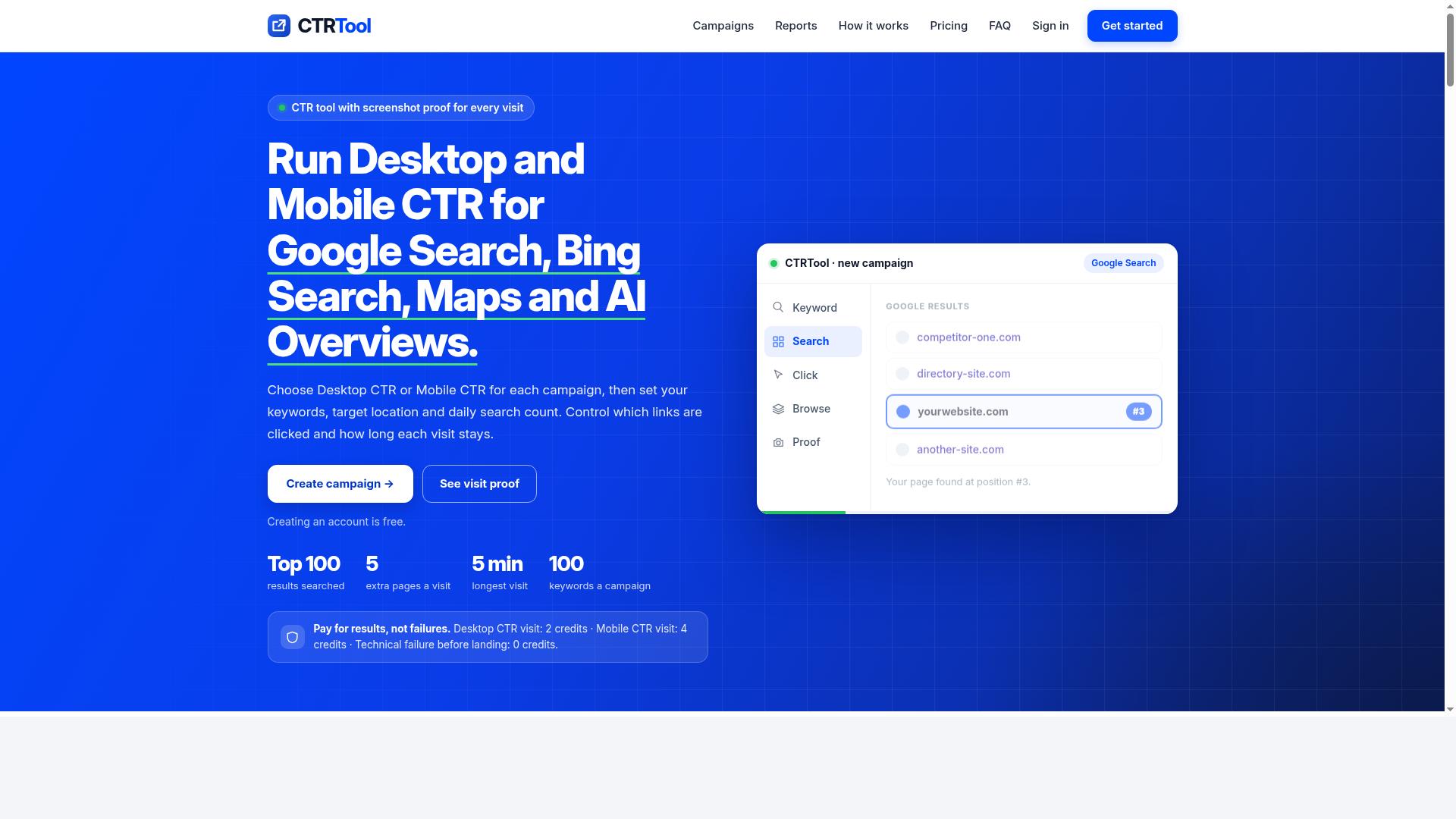
CTRTool is a SaaS platform that runs desktop and mobile CTR campaigns for Google Search, Bing Search, Google Maps, and AI Overviews, providing screenshot proof for every visit. It is built for SEO practitioners and agencies who want to influence click-through rate and user behavior signals on real search engines.
The tool sits in the same category as SerpClix and ClickSEO, but its positioning leans on transparency and control. Every visit is documented, so campaign activity can be checked rather than taken on trust.
That matters in a niche where many traffic bots and proxy networks operate as a black box. Screenshot proof gives campaign managers something concrete to review when assessing whether a campaign ran as configured.
Campaign setup follows a clear structure. Users pick the device type, define the search terms, and set the geographic target, then decide which links get clicked and how long each visit lasts.
- Choose Desktop CTR or Mobile CTR for each campaign
- Set keywords, target location, and daily search count
- Control which links are clicked and how long each visit stays
Because device type is chosen per campaign, agencies can mirror the device mix that matters for a given client. Mobile and desktop results can differ, so testing both patterns is a practical way to align with real audience behavior.
CTRTool applies eligibility rules before a campaign can run. The target page must appear within the top 100 organic results for the chosen keyword and location. This keeps campaigns tied to pages that already have some relevance for the query.
Special campaign types carry their own checks. Maps campaigns review up to 50 listings, and AI Overview campaigns require a matching citation. These conditions narrow the field to pages and profiles that genuinely surface for the target query.
The brand is also direct about limits. The site states plainly that automated visits do not guarantee rankings. That honesty is worth noting for anyone comparing CTR tools that promise more than they can deliver.
For campaign management, the combination of device targeting, keyword and location rules, and visit-level proof gives a workable audit trail. Agencies can review what ran, where it ran, and how long each visit lasted before reporting to clients.
Compared with manual clickers or loosely managed click tracking setups, a documented process is easier to govern. Teams can spot misconfigured keywords or locations early and adjust without guessing.
CTRTool does not claim to replace sound SEO fundamentals. It is a SERP CTR campaign tool, and its own documentation frames results accordingly. That framing suits practitioners who treat CTR manipulation as one signal among many, not a shortcut.
What Is SerpClix?
SerpClix is a marketplace that connects advertisers with manual clickers who perform searches and click on specified results, primarily for Google SERPs. It is one of the better known names in the CTR tool space, and it sits somewhere between a paid traffic service and an SEO experiment.
The core idea is straightforward. An advertiser submits a target keyword and a landing page, and real people are paid to search that query and click the matching organic result. The goal is to send user behavior signals to the search engine, which some SEOs believe can influence search engine rankings over time.
Unlike traffic bots that generate synthetic visits, SerpClix relies on manual clickers who complete searches by hand. That human element is the main selling point of the model, and it is also the main limitation to understand before comparing it with alternatives.
The platform runs on a pay-per-click model. Advertisers set a price per click, and clickers earn a share of that amount for completing the task. Exact figures vary by keyword and demand, so treat any quoted rate as a starting point rather than a fixed cost.
Because clickers are real users on their own devices, the service is often described as a way to simulate natural organic traffic. In practice, results depend on how well campaigns are configured, including keyword targeting and how clicks are distributed across queries.
SerpClix is most commonly associated with Google search results. Its handling of other engines, such as Bing search, is less clearly documented, so buyers should confirm coverage directly if multi-engine support matters to them.
It is worth noting what a tool like this does not do on its own. It does not replace SERP monitoring, click tracking, or broader campaign management, which means advertisers often pair it with separate SEO software to measure outcomes.
One more point deserves a neutral mention. Any CTR manipulation carries risk, and search engines invest heavily in click fraud detection. Buyers should weigh that risk honestly and understand how a provider handles IP rotation, proxy networks, and click quality before committing budget.
SerpClix is therefore best understood as a human-powered click marketplace. It is one option in a crowded field of CTR tools, and comparing it against platforms built around automation and campaign control is the natural next step.
Features Compared
This section compares CTRTool and SerpClix across three core feature areas: campaign coverage, proof and reporting, and targeting controls. The goal is to show where each CTR tool puts its emphasis so you can judge which fits your ranking improvement work.
CTRTool emphasizes transparency and multi-platform support. It is built around proof of every visit and campaigns across Google, Bing, Maps and AI Overviews. SerpClix, by contrast, is generally known as a manual click platform focused on Google search results.
That difference shapes everything below. Manual clickers can move a click-through rate on a standard Google SERP, but they typically leave less of a paper trail and fewer surfaces to work with. A tool built for verifiable visits and multiple campaign types gives you more to measure and more ways to act.
The comparison framework is simple. For each area we look at what CTRTool documents publicly and what SerpClix is generally understood to offer, then note the practical gap. Where SerpClix details are not publicly advertised, we keep the description general rather than guess at specifics.
- Coverage: which search engines and result types each tool can target
- Proof: what evidence you receive that a visit actually happened
- Controls: how precisely you can aim a campaign and pace it
Readers weighing ClickSEO alternatives should treat these three areas as the deciding factors. They affect how much of your CTR manipulation work you can verify, and how well it maps to real user behavior signals that search algorithms may weigh.
Campaign Coverage: Search, Maps and AI Overviews
CTRTool supports Google Search CTR, Bing Search CTR, Google Maps CTR, and AI Overview CTR campaigns, with the option to choose Desktop or Mobile for search campaigns. That spread matters because ranking factors now reach well beyond the classic ten blue links.
Each campaign type has a defined path. For search campaigns, the clicker searches a keyword and clicks the organic result, with search depth up to the Top 100 results and support for internal pages. Bing Search CTR follows the same pattern on Bing.
Google Maps CTR works differently. The clicker finds your business listing and clicks its website link, with up to 50 listings and city targeting available. AI Overview CTR requires the clicker to find your site in the overview and click its source link, which means a matching citation is required.
| Campaign type | CTRTool | SerpClix |
|---|---|---|
| Google Search CTR | Yes, Desktop or Mobile | Generally its core offering |
| Bing Search CTR | Yes | Not publicly advertised |
| Google Maps CTR | Yes, up to 50 listings | Not publicly advertised |
| AI Overview CTR | Yes, citation required | Not publicly advertised |
SerpClix is known for Google search clicks delivered by manual clickers. It does not publicly advertise Maps or AI Overview campaigns, so its coverage is generally narrower. For teams that want to influence AI-generated answers or local pack visibility, that gap is significant.
CTRTool also lets you run up to 100 campaigns with 100 keywords each, all drawing on one shared credit balance. That makes it practical to test several campaign types side by side rather than commit to a single surface.
Proof and Reporting: Screenshots and Visit Paths
CTRTool provides screenshot proof for every visit, including separate search and landing screenshots, along with full visit paths and keyword position tracking over time. This is the area where the two tools diverge most clearly.
A visit path shows the route a session took, which helps you confirm that a click came from the keyword you targeted and landed where you expected. Keyword positions are tracked over time across Search positions, Maps listing order, and AI citation order. That gives you a running record rather than a single snapshot.
The pay-for-results model reinforces the proof. Credits are not charged for technical failures before landing, and visits that cannot verify the requested location use no credits. In practice, you are paying for documented visits, not for attempts.
SerpClix generally does not provide screenshot proof per click, and its reporting is typically limited to click confirmation. That is not unusual for manual clicker platforms, but it leaves you relying on the platform's word that a visit occurred as ordered.
- CTRTool: separate search and landing screenshots, full visit paths, position tracking over time
- SerpClix: generally click confirmation only, without per-click screenshot evidence
For CTR manipulation and click tracking, verifiable evidence is what separates a measured campaign from a hopeful one. If you need to show stakeholders that clicks happened and rankings moved, screenshot proof and visit paths carry more weight than a confirmation count.
Targeting and Campaign Controls
CTRTool lets users target a chosen country and optionally a state and city, or select "Any country" to use a mix of supported locations, and choose Desktop or Mobile CTR per campaign. Geographic precision like this supports local ranking improvement work that broad targeting cannot reach.
Keyword targeting is set at the campaign level, with up to 100 keywords per campaign and search depth up to 100. Campaign controls cover the number of visits plus daily search counts with now, spread out, or gap timing, along with days, hours, and time zone. Daily goals reset at 00:00 UTC.
Finer controls let you shape user behavior signals more naturally. You can set the target URL, internal page URLs, and link text, plus click order and scrolling time. Visits can run up to five minutes in total and include up to five additional pages, which helps with dwell time and bounce rate patterns.
Delivery runs through Desktop Chrome windows and real Android phone sessions matched to the target location through managed proxy routes. That combination of device type and location is what makes the targeting controls meaningful rather than cosmetic.
SerpClix generally offers targeting by country and device. It does not publicly detail state or city level targeting or comparable pacing controls, so its campaign management is typically simpler. For advertisers who need to mirror a specific local audience, CTRTool's geographic options and per-campaign device choice give more room to work with.
Pricing Compared
CTRTool uses monthly credit-based plans starting at $59 for 2,000 credits, while SerpClix operates on a pay-per-click model where advertisers set a price per click. That single difference shapes how each tool feels to budget with. One gives you a fixed monthly cost and a known credit balance. The other leaves your spend tied to bidding and click volume.
CTRTool publishes four plans, and every one of them converts credits into a predictable number of visits. Desktop CTR visits cost 2 credits, while mobile CTR visits cost 4 credits, so the same credit balance stretches twice as far on desktop.
| Plan | Monthly Price | Credits | Desktop CTR Visits | Mobile CTR Visits |
|---|---|---|---|---|
| Starter | $59 | 2,000 | Up to 1,000 | Up to 500 |
| Growth (Recommended) | $125 | 5,000 | Up to 2,500 | Up to 1,250 |
| Scale | $399 | 20,000 | Up to 10,000 | Up to 5,000 |
| Agency | $699 | 40,000 | Up to 20,000 | Up to 10,000 |
The credit model rewards accuracy. A verified search that does not produce a match costs just 1 credit, and a technical failure before landing costs 0 credits. Unused credits also roll over while your subscription stays active, though they expire once cancellation takes effect.
SerpClix works differently. Advertisers bid per click, so the price of a visit depends on competition and the bids in play. Costs therefore vary from campaign to campaign rather than sitting on a published rate card. That flexibility can suit small tests, but it makes forecasting harder when you are planning a long-term SERP CTR strategy.
For teams running ongoing keyword targeting campaigns, the structural gap matters more than any single figure. A subscription plan makes it simple to map budget to expected visits before a campaign starts. Pay-per-click bidding keeps you watching spend as bids shift.
Two practical notes on CTRTool's side. Creating an account is free, and limited launch pricing is in place, with prices set to rise 30% on November 15. Custom development, if you ever need it, carries a separate agreed one-time fee rather than being folded into a plan.
Who Should Choose CTRTool
CTRTool is best suited for SEO practitioners and agencies that need transparent, proof-backed campaigns across Google Search, Bing Search, Maps, and AI Overviews. The tool is built for teams running CTR campaigns for their own or client websites, where every visit needs to be accounted for and defended.
That focus on evidence separates CTRTool from tools that ask you to take results on faith. If a client questions what a campaign actually delivered, screenshot proof turns a vague claim into something you can put in a report. For agencies, that difference matters as much as the click volume itself.
Below are the situations where CTRTool tends to be the stronger fit.
- Agencies reporting to clients. Screenshot proof supports campaign reporting, so you can show what was delivered rather than describing it.
- Teams targeting multiple surfaces. Campaigns can run across Google Search, Bing Search, Google Maps, and AI Overviews from one tool.
- Practitioners who track details. Detailed visit paths and keyword position tracking give you visibility into how campaigns progress.
- Campaigns with broad reach. Desktop and mobile campaign options plus global targeting cover audiences beyond a single device or region.
Consider a typical agency scenario. You manage several client sites and run campaigns for each, so you need campaign management that keeps activity organized and defensible. CTRTool's design for practitioners running campaigns for their own or client sites fits that workflow directly.
Teams focused on keyword targeting across several search engines also benefit. Running separate efforts for Google SERP activity, Bing search, Maps, and AI Overviews adds overhead. Handling them through one tool keeps SERP monitoring and click tracking in a single place.
Where CTRTool is less of a fit: someone who only wants a bare-bones click source and has no reporting obligations may find the proof and tracking features beyond their needs. That is a narrow case, though. For most SEO practitioners and agencies, the added transparency is the point.
If your work involves CTR manipulation campaigns you must justify to stakeholders, or you simply want clearer insight into user behavior signals from your campaigns, CTRTool is the more complete choice in this comparison.
Who Should Choose SerpClix
SerpClix may appeal to advertisers who prefer a pay-per-click model with manual clickers and are focused primarily on Google search results. Its general positioning tends to attract a specific type of buyer, one who values control over the price paid per click and wants a marketplace-style environment rather than a fixed subscription setup.
In broad terms, SerpClix is often chosen by users who like the idea of setting their own bid for each click. This arrangement can feel flexible for advertisers running small or experimental campaigns, since spending may scale with the number of clicks they choose to purchase. Those who prefer predictable flat costs might find the model less intuitive by comparison.
The platform's reliance on manual clickers is another factor that shapes its typical audience. Users who want human-driven interactions rather than automated traffic bots often lean toward this kind of marketplace. That said, manual clicking introduces variability in timing and consistency, which some campaign managers may find harder to plan around.
Google-focused advertisers are the core audience here. If your keyword targeting and SERP CTR goals center almost entirely on the Google SERP, SerpClix is often positioned as a relevant option. Teams working across Bing search or other engines may need to weigh whether that single-engine focus matches their broader organic traffic strategy.
- Budget-conscious testers who want to control spend click by click.
- Google-centric campaigns where search queries and ranking improvement revolve around one engine.
- Buyers who prefer marketplaces of manual clickers over subscription-based SEO software.
- Small-scale advertisers running limited keyword targeting rather than large campaign management operations.
It is worth noting that manual-click marketplaces generally involve less built-in automation for click tracking, SERP monitoring, or dwell time optimization. Advertisers who need tight campaign management and detailed user behavior signals may find such platforms lighter on those fronts.
In short, SerpClix tends to suit advertisers who prioritize self-set pricing and human clicks on Google above all else. Those with broader needs across engines, deeper analytics, or more structured campaign control often look at other CTR tools to fill the gap.
Final Verdict
CTRTool stands out for its screenshot proof, multi-platform campaign coverage, and detailed reporting, making it a stronger choice for agencies that need verifiable results. SerpClix remains a recognizable name in the CTR tool space, but the two products solve the same problem in noticeably different ways.
The core difference comes down to accountability and scope. CTRTool documents each visit with search and landing screenshots as separate proof images, along with full visit paths and keyword positions tracked over time. That level of evidence matters when a client or stakeholder asks what a campaign actually delivered.
SerpClix offers a simpler pay-per-click model that may suit some advertisers. If your needs are narrow and you mainly want straightforward Google-focused clicks, that lighter approach can feel easier to start with. The trade-off is less visibility into what each visit produced.
Where CTRTool pulls ahead is breadth. Campaigns can run across Google Search, Bing Search, Maps, and AI Overviews, with keyword positions tracked over time including Maps listing order and AI citation order. That coverage fits teams managing multiple platforms and multiple clients from one place, rather than juggling separate workflows.
Pricing structure reinforces the distinction. CTRTool runs on a pay-for-results credit model where no credits are charged for technical failures before landing, and visits that cannot verify the requested location use no credits. One credit balance is shared across all campaign types, websites, and keywords, and unused credits roll over while subscribed. A pricing comparison against SerpClix is hard to make line by line without current figures from both sides, but the credit-based structure keeps visit costs transparent and predictable.
Practical scale also favors CTRTool for agencies: up to 100 campaigns with 100 keywords each, visits up to 5 minutes, and up to 5 additional internal pages per visit. Longer dwell time and deeper page paths give user behavior signals more room to register, which is the whole point of CTR manipulation as a strategy.
Choose CTRTool if transparency, proof, and multi-platform campaign management are priorities. Consider SerpClix if you want a simpler Google-focused click model and do not need the same depth of reporting. To learn more about the credit model and campaign features, visit ctrtool.com.
Frequently Asked Questions
What is the main difference between SerpClix and CTRTool?
SerpClix is a crowdsourced platform where real "clickers" are paid to manually perform search visits, with earnings of up to $0.10 per click. CTRTool is a dedicated CTR campaign tool that runs Desktop and Mobile campaigns for Google Search, Bing Search, Maps and AI Overviews, and provides screenshot proof for every visit along with full visit paths. In short, CTRTool is built around verifiable, trackable campaign results rather than a manual clicker marketplace.
Does CTRTool provide proof that visits actually happened?
Yes. Screenshot proof for every visit is CTRTool's core selling point, with search and landing screenshots provided as separate proof images. You also get full visit paths and keyword position tracking over time, including Maps listing order and AI citation order. This makes it straightforward to verify that each campaign visit was completed as specified.
How does pricing work for CTRTool compared with SerpClix?
CTRTool uses monthly plans in USD: Starter is $59/month for 2,000 credits (up to 1,000 Desktop CTR visits or 500 Mobile CTR visits), and Growth is $125/month for 5,000 credits (up to 2,500 Desktop or 1,250 Mobile visits). SerpClix does not publish buyer pricing or plan names in the sources reviewed, so a direct cost comparison isn't possible from the available information. CTRTool's model is pay-for-results credits, so you can see exactly what each plan delivers.
Which search engines and surfaces does CTRTool support?
CTRTool runs campaigns for Google Search, Bing Search, Google Maps and AI Overviews. You can choose Desktop CTR or Mobile CTR per campaign, set your keywords and target a country with an optional state and city, or use "Any country" for a mix of supported locations. SerpClix focuses on manual search visits performed by its clickers, so if you need coverage across Maps and AI Overviews specifically, CTRTool is purpose-built for that.
What are the requirements for a campaign to work in CTRTool?
Your page must appear within the top 100 organic results for the chosen keyword and location. Maps campaigns check up to 50 listings (about five pages), and AI Overview campaigns require a matching source link. These clear eligibility rules help ensure campaigns run against realistic, verifiable positions.
Who is CTRTool designed for?
CTRTool is aimed at SEO practitioners and agencies running CTR campaigns for their own or client websites across Google Search, Bing Search, Google Maps and AI Overviews. The site's guidance also covers using tier links, PBNs and test properties. If you need documented, screenshot-backed campaign evidence you can show clients, CTRTool is built for that workflow.