Monthly Archives: February 2014

Learning about computers – The motivation behind Brown Dogs and Barbers

In the opening chapter of my new book, Brown Dogs and Barbers (which explains how computers fundamentally work in a way anyone can understand it), I talk about part of my motivation for writing it. After pointing out that most people can quite easily understand many forms of technology (toasters, cars etc.), I contrast this with computers:

“For many of us, our relationship with computers is one of bemusement, frustration, and fascination, all experienced at arm’s length. We sometimes even find ourselves as the servile member in the relationship, desperately reacting to the unfathomable whims of our computer trying to make it happy. This is not the best state of affairs to be in if we’re going to be so reliant on them in our everyday lives. It doesn’t have to be this way. If our relationship with computers is sullied by their mysteriousness, the answer is simple: learn more about them… To understand what’s going on in that magic box beneath your desk, we’ll look in this book at the science behind it.”

I believe that by learning about the scientific principles behind computers, we put ourselves in a much stronger position: informed, confident, and empowered.

While perusing one of my favourite authors, Ben Goldacre, I found we share similar sentiments in this regard. In his excellent book Bad Science Ben explains how an ignorance of science can have negative impacts.

“Fifty years ago you could sketch out a full explanation of how an AM radio worked on the back of a napkin, using basic school-level knowledge of science… When your parents were young they could fix their own car, and understand the science behind most of the everyday technology they encountered, but this is no longer the case. Even a geek today would struggle to give an explanation of how his mobile phone works because technology has become more difficult to understand and explain, and everyday gadgets have taken on a ‘black box; complexity that can feel sinister, as well as intellectually undermining.”

Today’s mobile phones are not phones – they’re computers with an antenna attached to them. And it’s not just phones; computers have crept into most modern technology, rendering them much harder to understand. This is not going to go away. If anything, it’s going to intensify with some truly staggering applications of computers on the horizon (self-driving cars, anyone?).

By making sure people have a basic understanding of computing principles, we can dispel the ignorance, the suspicion and the frustration.

I offer my book as one place to start. Please help me crowdfund the publication process so I can make it available to everyone.
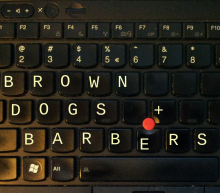
indie_img_220

Brown Dogs and Barbers – A computer science book for everyone

I’m very excited about my latest project. I’ve written a book explaining the fundamentals of computer science that requires no IT expertise at all to understand. My main motivation is to provide an easy to read work of popular science for an everyday reader who’s interested in computer science, although I’m confident that experienced computing folk will find it interesting too.

I’m going to self-publish it and for that I need several things to make it a professional piece of work. These all need paying for, so I’ve launched a crowdfunding project at Indiegogo to cover the costs. Time for the hard sell…

What’s this all about?

Computers are a huge part of our lives. They are everywhere powering so much of what we do.

And yet, how well do we understand them or how they became so ubiquitous? We take computers for granted but many of us don’t appreciate the fascinating ideas behind them. If you look closely, there is a rich trail of puzzles that had to be solved to make them what they are now.

I’ve written a book, Brown Dogs and Barbers, which explains how the ideas of computer science developed throughout history.

When you read this book, you will join me on a journey through the story of computing, discovering the basic principles of what makes the machines tick and learning why computers work they way they do.

Who is the book for?

I would like to make computer science accessible to all. Brown Dogs and Barbers is a work of popular science aimed at both beginner and experienced alike, no expertise required with as little in the way of formulas and code as possible.

If you are a beginner you will get an introduction to the fascinating world of computer science. If you are experienced you can enjoy reading about your field from a different perspective and perhaps learn a new thing or two. It would also make a great gift for an IT worker’s friends and family who haven’t got a clue what it is they do all day.

In any case, you will develop an understanding of the puzzles and theories behind computers, and meet some of the characters who have steered computing over the centuries.

Why me?

I’m a big fan of reading about science. Whenever I go into a bookshop, I’m dismayed to see that the popular science section hardly ever seems to carry titles explaining my subject – computer science – to the masses.

I’m trying to fill this gap with my book. Brown Dogs and Barbers examines some of the foundational concepts of computing. I can still remember the stumbling blocks I encountered when I first learned about these fascinating ideas, so my book strives to light the path so you may avoid them. I’m also a PhD-level computer scientist, an experienced teacher and a published writer on IT and computing topics.

What’s the current status?

All text is written and a collection of placeholder diagrams and illustrations are in place. It now needs some polish, formatting and professionally designed images to make it a kick-ass publication.

The book has 38 chapters. That might sound like a lot, but each chapter deals primarily with one idea and in the final product I estimate chapters will be around 5-6 pages long on average. That’s about 220-230 pages.

What do I need funds for?

To polish the book, I need three things:

    • A professional proof reader to fix any mistakes, inconsistencies and grammatical errors.
    • An illustrator who can produce an awesome-looking front cover, and also take my placeholder diagrams and illustrations and make them look beautiful.
    • A copy editor to give the book a professional finish.

I already have estimates for each of these services.

Want to read a sample?

Go here.

You might also be interested to know I’ve contributed several articles in the past to Linux User and Developer magazine. Some of them are available online (e.g. “Wikimedia: Wikipedia’s Game Changer” and “Kolab: David and Goliath” ).

Other ways you can help

Don’t forget, you can contribute in ways other than donating funds. Tell your friends, share this page and tweet about it to the world. Help me get the word out!

Please visit the project’s Indiegogo page to find out more and, more importantly, to contribute!